
Respiratory Syncytial Virus Circulation and Motor Neuron Disease Mortality in the United States: An Exploratory Epidemiological Analysis
Background: Respiratory complications are a major contributor to mortality in amyotrophic lateral sclerosis (ALS), a type of motor neuron disease (MND). Whether seasonal circulation of respiratory syncytial virus (RSV) is associated with fluctuations in MND mortality remains uncertain. This exploratory study investigated associations between RSV laboratory surveillance positivity and MND mortality in the United States.
Methods: Monthly deaths attributed to MND (ICD-10 G12.2) were obtained from CDC WONDER for 2011–2019 and analysed alongside RSV surveillance data from the National Respiratory and Enteric Virus Surveillance System. Poisson regression was used to evaluate national temporal associations and regional associations across the ten US Department of Health and Human Services regions. Analyses included alternative seasonal adjustments, restricted study periods, comparator mortality outcomes and small-cluster inference.
Results: Higher national RSV polymerase chain reaction (PCR) positivity was positively associated with MND mortality (incidence rate ratio [IRR] 1.051, 95% CI 1.029–1.074, per five-percentage-point increase). Conversely, the regional analysis produced an inverse association (IRR 0.970, 95% CI 0.944–0.998). The corresponding regional association was not conventionally significant under a wild-cluster score test (P = 0.0586). Earlier national models also demonstrated sensitivity to seasonal adjustment and study-period restriction. The opposing national and regional estimates suggested that the findings were dependent on the geographical level and statistical specification of the analysis.
Conclusion: This exploratory investigation did not establish a robust, geographically consistent association between RSV circulation and MND mortality. The findings illustrate the limitations of using aggregate respiratory-virus surveillance to investigate mortality in neurodegenerative disease.
Keywords: amyotrophic lateral sclerosis; motor neuron disease; respiratory syncytial virus; mortality; CDC WONDER; epidemiology; ecological analysis
Open research materials
Citation of the code used for data analysis and to generate the figures, archived from the project’s GitHub repository.
https://doi.org/10.5281/zenodo.23643670Citation of the data produced by the analysis, prepared for public access and reuse.
https://doi.org/10.5281/zenodo.236437221. Introduction
Amyotrophic lateral sclerosis (ALS) is a progressive neurodegenerative disorder characterised by degeneration of upper and lower motor neurons, leading to muscle weakness, paralysis and, ultimately, respiratory dysfunction. Respiratory complications are among the principal contributors to mortality in ALS. A US mortality study identified respiratory failure and pneumonia among the conditions frequently recorded on death certificates of individuals with ALS [1].
This vulnerability raises the possibility that circulating respiratory pathogens could contribute to short-term fluctuations in mortality among individuals with advanced motor neuron disease (MND). Respiratory syncytial virus (RSV), a common seasonal respiratory pathogen, represents one plausible candidate. However, an association between population-level RSV circulation and MND mortality would not necessarily indicate direct infection, accelerated neurodegeneration or a causal contribution to death.
The availability of publicly accessible mortality and respiratory-virus surveillance datasets provides an opportunity to investigate this hypothesis using ecological time-series methods. CDC WONDER provides national mortality statistics derived from death certificates, while the National Respiratory and Enteric Virus Surveillance System (NREVSS) records laboratory testing activity across the United States [2,3].
The present study initially investigated whether periods of elevated RSV activity were associated with increased MND mortality nationally. Subsequent analyses assessed whether any observed relationship was robust to alternative statistical specifications and whether it persisted when examining geographical variation across US regions.
2. Methods
2.1. Study design and mortality data
A retrospective ecological analysis was conducted using publicly available US mortality and respiratory-virus surveillance data covering January 2011 to December 2019.
Monthly mortality counts were obtained from the CDC WONDER Underlying Cause of Death database [2]. MND deaths were identified using ICD-10 code G12.2, which includes ALS and other motor neuron disorders. Consequently, the outcome was MND mortality rather than ALS-specific mortality.
The primary outcome was the monthly number of deaths for which MND was recorded as the underlying cause. National and regional mortality data were examined, with regional observations assigned to the ten US Department of Health and Human Services (HHS) regions.
Additional mortality datasets were assembled for Parkinson's disease (ICD-10 G20), transport accidents and influenza/pneumonia (ICD-10 J09–J18). These were used as exploratory comparator outcomes.
2.2. RSV surveillance data
RSV activity was assessed using the historical NREVSS laboratory surveillance dataset [3]. The dataset contains weekly counts of RSV tests and positive detections reported by participating laboratories, categorised by diagnostic testing method and HHS region.
RSV test positivity was calculated as the proportion of positive tests among tests performed. Because the distribution of diagnostic testing methods changed over time, PCR-only RSV positivity was selected for the principal follow-up analyses.
Weekly observations were aggregated into monthly exposure estimates. The principal exposure represented mean RSV positivity over the index month and preceding month, with model estimates expressed per five-percentage-point increase.
For the final harmonised analysis, the national exposure was constructed as a test-volume-weighted mean of the same regional PCR-based exposure series used in the regional analysis. This ensured consistency between national and regional exposure definitions.
2.3. Statistical analysis
Initial national analyses used Poisson regression with a log link, adjustment for long-term temporal trends and seasonal variation, and an offset for the number of days in each month. Newey–West heteroskedasticity- and autocorrelation-consistent standard errors were used for inference.
Sensitivity analyses examined alternative seasonal specifications, including one or two Fourier harmonics and calendar-month fixed effects. Additional analyses excluded the earliest years, adjusted for influenza activity, excluded RSV surveillance outliers and assessed the influence of individual calendar years. Negative-binomial regression was investigated, although audited fits with convergence failures were not considered reliable.
The final harmonised national analysis used Poisson regression with year and calendar-month effects and heteroskedasticity- and autocorrelation-consistent standard errors, focusing on a six-month lag specification.
Regional models were estimated using high-dimensional fixed-effects Poisson regression. These included region-year and region-specific calendar-month effects, together with national year-month effects in within-region analyses, to isolate regional variation after accounting for nationwide temporal changes.
A complementary joint model included both the common national RSV series and each region's deviation from that series, allowing the national temporal and regional components to be compared within a common model.
Given the limited number of geographical clusters (ten HHS regions), additional inference was performed using restricted Poisson efficient-score wild-cluster sign-flip tests, enumerating all 1,024 possible cluster sign patterns. Complete enumeration of these patterns did not make the procedure an exact finite-sample test.
3. Results
3.1. RSV surveillance characteristics and study coverage
Historical RSV surveillance data demonstrated a substantial change in the distribution of diagnostic testing methods. PCR accounted for 30.4% of recorded RSV tests in 2011, increasing to 89.6% in 2019.
This change motivated the use of PCR-only positivity in subsequent analyses, although restricting the exposure to PCR tests could not eliminate potential changes in laboratory participation, population coverage or testing practices.
The final harmonised analysis included 107 of the 108 calendar months between January 2011 and December 2019, corresponding to 1,070 complete region-month observations. One calendar month was excluded because of a suppressed regional MND mortality cell. Suppressed counts were neither imputed nor reconstructed.
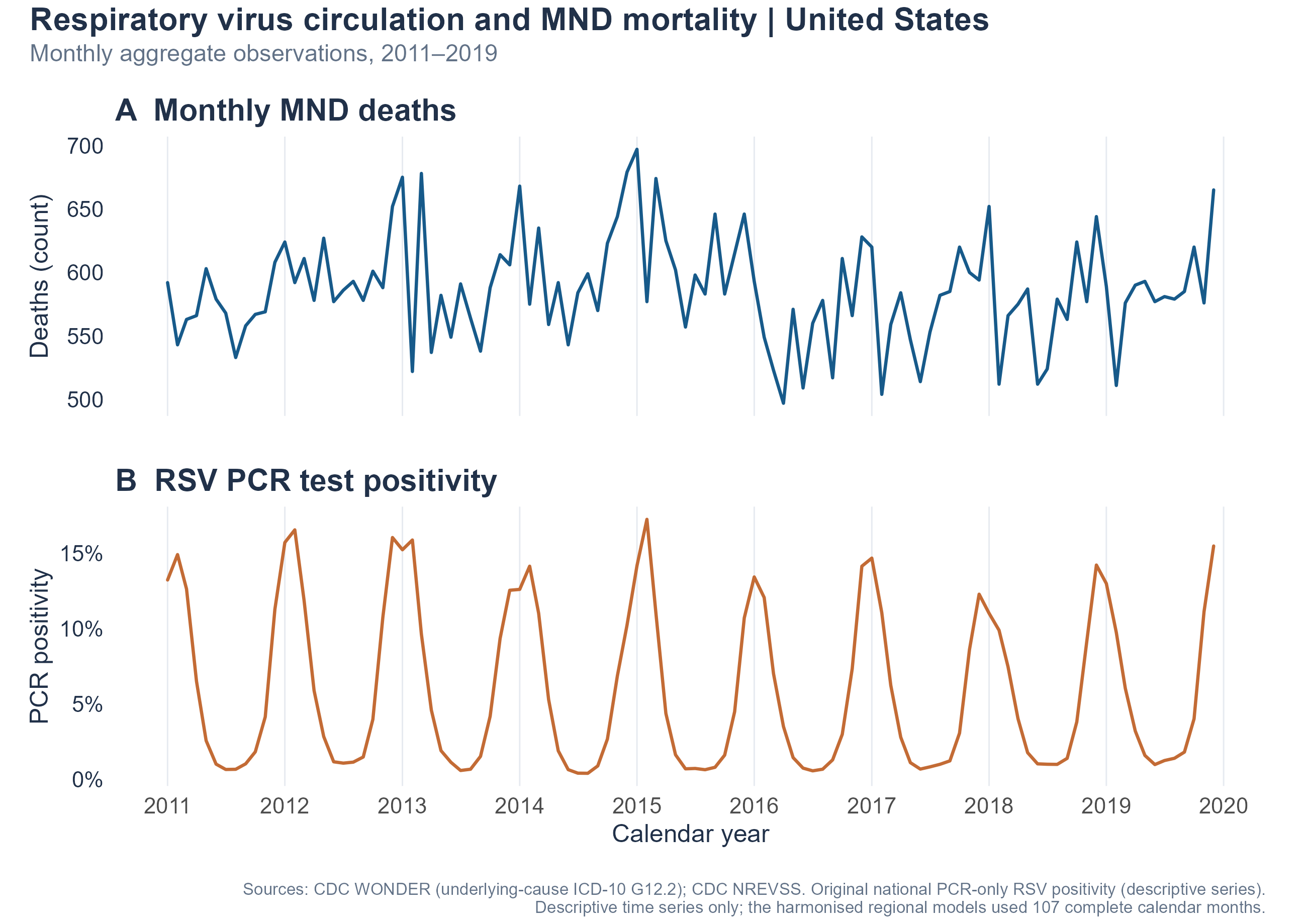
Monthly MND mortality and RSV positivity are illustrated in Figure 1, providing a descriptive overview of their temporal variation.
3.2. Initial national associations and sensitivity analyses
In the initial national models, the association between RSV activity and MND mortality varied according to the RSV exposure definition and seasonal adjustment.
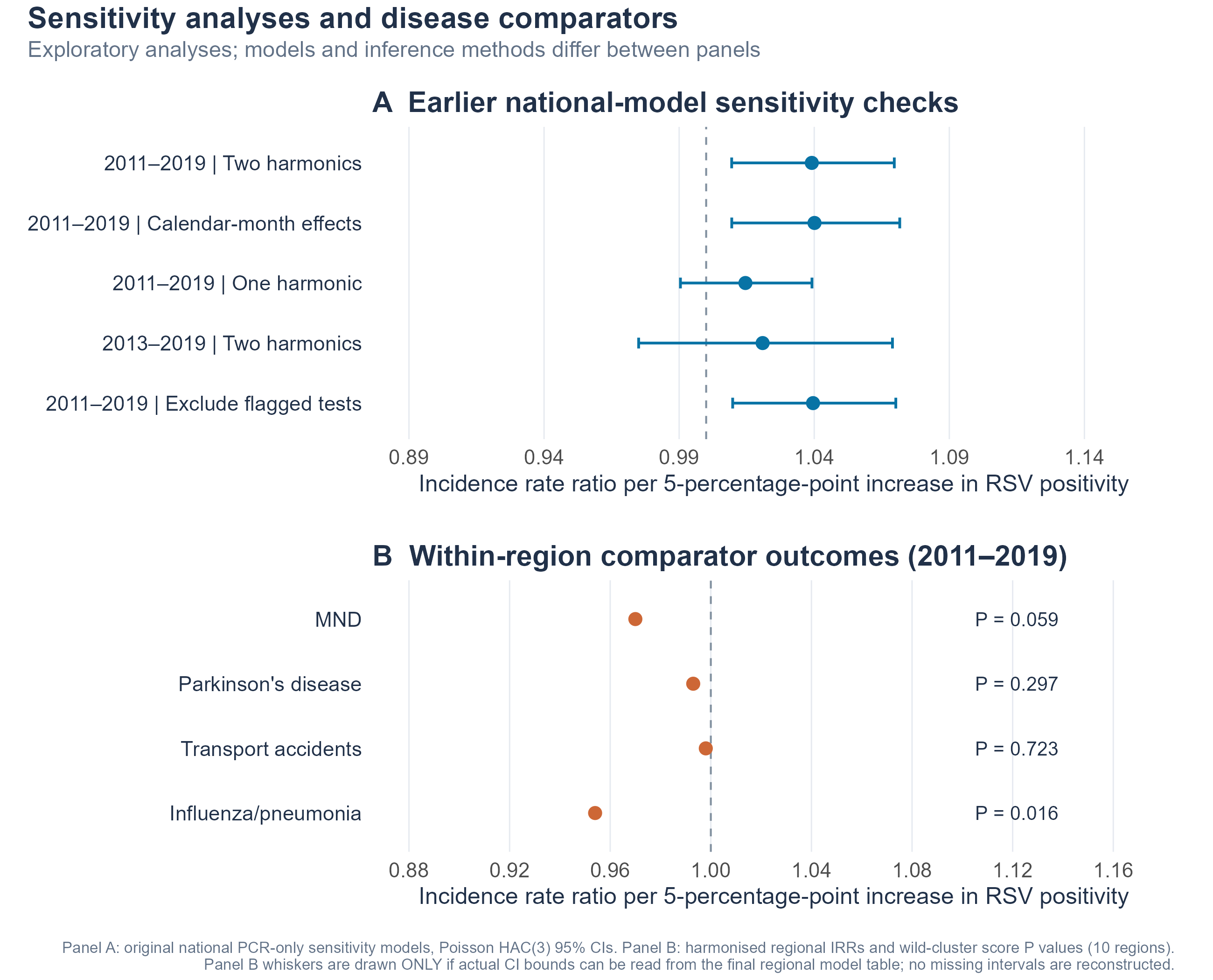
Using pooled RSV positivity across diagnostic methods, the estimated association was relatively modest (IRR 1.026, 95% CI 0.999–1.055; P = 0.062). Restriction to PCR-only positivity produced a larger association (IRR 1.039, 95% CI 1.009–1.070; P = 0.0094) when adjusting for two seasonal Fourier harmonics.
However, the association weakened when seasonal variation was represented using a single Fourier harmonic (IRR 1.015, 95% CI 0.991–1.039; P = 0.239). Restricting the analysis to 2013–2019 also reduced the estimated association in this modelling framework (IRR 1.021, 95% CI 0.975–1.069; P = 0.378).
Excluding flagged RSV surveillance outliers had little effect on the original two-harmonic estimate (IRR 1.040, 95% CI 1.010–1.070; P = 0.0088).
These observations indicated that the national association was sensitive to choices concerning seasonal adjustment and study period, rather than being consistently reproduced across plausible specifications.
3.3. Harmonised national and regional analyses
The final harmonised national model identified a positive temporal association between RSV PCR positivity and MND mortality (IRR 1.051, 95% CI 1.029–1.074). The corresponding estimate for 2013–2019 was also positive (IRR 1.056, 95% CI 1.026–1.088).
These estimates differed from the earlier national sensitivity models because the final analysis used a harmonised RSV exposure definition and a different temporal adjustment strategy.
In contrast, the regional model produced an inverse association between local RSV positivity and MND mortality (IRR 0.970, 95% CI 0.944–0.998). For 2013–2019, the corresponding regional estimate was 0.962 (95% CI 0.919–1.008).
The joint model similarly estimated a positive national temporal component (IRR 1.047, 95% CI 1.018–1.077) and a negative regional-deviation component (IRR 0.973, 95% CI 0.949–0.997). The exponentiated difference between their coefficients was 1.077 (P = 0.0027 using approximate cluster-based inference).
Figure 2 illustrates the contrasting national and regional associations, including the restricted-period analyses.
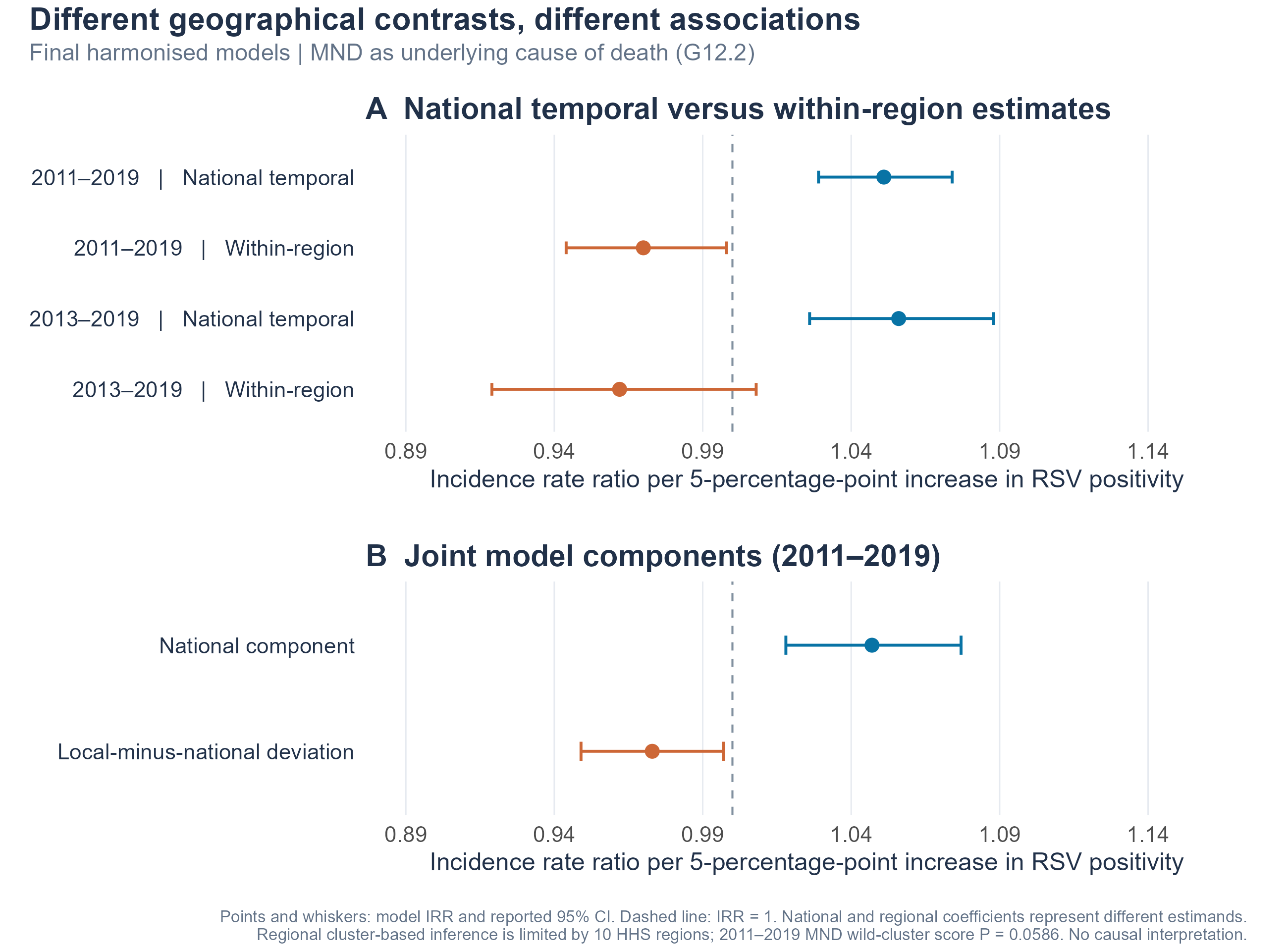
Importantly, the estimates represented different sources of exposure variation. The national association reflected temporal changes shared across the country, while the regional component reflected geographical deviations after extensive adjustment for temporal factors. Their opposing directions therefore did not establish contradictory biological effects.
3.4. Small-cluster inference and comparator outcomes
Because the regional analysis contained only ten independent geographical clusters, conventional confidence intervals could underestimate statistical uncertainty.
The wild-cluster score test did not provide conventional 5% significance for the regional MND association in the complete study period (P = 0.0586). The corresponding result for 2013–2019 was also non-significant (P = 0.0938).
Comparator-outcome analyses showed limited evidence of regional associations for Parkinson's disease (IRR 0.993; wild-cluster P = 0.2969) or transport accidents (IRR 0.998; P = 0.7227). In contrast, influenza/pneumonia mortality demonstrated an inverse regional association (IRR 0.954; P = 0.0156).
These comparator findings did not establish MND specificity. The influenza/pneumonia result indicated that inverse regional associations were not unique to MND, although its relationship with RSV circulation could not be interpreted straightforwardly because respiratory pathogens and respiratory mortality share seasonal and epidemiological determinants.
The principal sensitivity and comparator results are summarised in Figure 3.
4. Discussion
This exploratory study investigated whether population-level RSV circulation was associated with MND mortality in the United States between 2011 and 2019. Although several national models suggested a positive association, the findings were not consistent across analytical approaches.
The most informative observation was the difference between national temporal and regional associations. National RSV activity may coincide with other seasonal factors relevant to mortality, including circulation of additional respiratory pathogens, environmental conditions, healthcare pressures and changes in patient care. Adjustment for measured seasonality does not necessarily eliminate these influences.
The regional models attempted to reduce confounding from nationally shared temporal factors by examining geographical deviations in RSV circulation. However, these analyses did not produce a robust positive relationship between RSV activity and MND mortality. Instead, an inverse association was observed, which did not remain conventionally significant under the more conservative small-cluster inference procedure.
The regional inverse estimate should not be interpreted as evidence that RSV exposure is protective in MND. Such a conclusion would be biologically unsupported by the present design and would confuse ecological statistical associations with individual-level effects.
Several limitations affect interpretation. First, surveillance positivity does not directly measure RSV infection prevalence in the population or establish whether individuals with MND were infected. Second, the geographical location of reporting laboratories does not necessarily correspond to the residence of the individuals represented by mortality records. Third, changes in testing practices and laboratory participation could introduce systematic measurement differences across time and regions.
Fourth, underlying-cause mortality records do not identify acute respiratory infections contributing to death, and the G12.2 category includes motor neuron disorders beyond ALS. The analysis also lacked individual-level information on disease stage, respiratory function, ventilation, comorbidities and infection history. Changes in the size and characteristics of the population at risk could not be fully accounted for using the available aggregate data.
Finally, the regional analysis was limited to ten geographical clusters, while the extensive sensitivity investigations were exploratory rather than prespecified. Consequently, conventional confidence intervals and individual P values should not be treated as definitive evidence.
Taken together, the results suggest that the observed national relationship may reflect shared temporal variation or other unmeasured influences rather than a reproducible association between local RSV circulation and MND mortality. The available data cannot determine whether RSV infection contributes to mortality among individuals with ALS.
5. Conclusion
National RSV circulation showed a positive association with MND mortality in several exploratory models, but the findings were sensitive to analytical specification and did not translate into a corresponding positive regional association.
These results do not provide robust evidence that RSV circulation contributes to MND mortality. Future investigations would require individual-level infection data linked to clinically characterised ALS cohorts, or alternative study designs capable of distinguishing infection-related mortality from broader seasonal variation.
The present report documents both the findings and the methodological reasons for not pursuing journal publication.
References
- Causes of death among United States decedents with ALS: An eye toward delaying mortality. Amyotrophic Lateral Sclerosis and Frontotemporal Degeneration. 2023.
- Centers for Disease Control and Prevention. CDC WONDER: Underlying Cause of Death, 1999–2020.
- Centers for Disease Control and Prevention. Respiratory Syncytial Virus Laboratory Data, National Respiratory and Enteric Virus Surveillance System (NREVSS).
- Centers for Disease Control and Prevention. National Respiratory and Enteric Virus Surveillance System: Overview.
Declarations
Ethics statement
This analysis used publicly available, aggregated mortality and surveillance data. No individual-level records were accessed, and no human participants were recruited or contacted.
Funding
No funding was used for this work.
Competing interests
The author declares no competing interests.
Disclaimer
This report describes an exploratory analysis of publicly available, aggregate surveillance and mortality data. It has not undergone external peer review. The findings should not be interpreted as evidence of an individual-level or causal relationship between RSV infection and MND mortality.